Cycle of Change
Individual cases will present to us with varying stages of motivation to change. It is important to understand that regardless of how hopeless someone feels about their ability to change, or opposition to doing so, there will always be ways we can work with them. The Cycle of Change (Prochaska & DiClemente) will help identify what stage in the journey of change somebody is at. It can be useful to discuss the cycle collaboratively with cases in order to recognise where they are and what might help them move forward. Below are the stages of the cycle, and some suggestions as to which skills or strategies may be useful to employ.
The Stages:
- Pre-contemplation: “I don’t need to change”. Individuals in this stage will be in denial that anything is wrong, or will think that there is nothing they can do about it, so there is no point in trying. They may avoid thinking/talking about change or decide that they are happy with their current choices (for example, that the benefits of their offending outweigh the negatives such as getting caught).
Strategies/Skills: In this early stage, building rapport and a strong working relationship is the most important task, this is the foundation to any work or discussions about change. Focus on using open questions and do not directly challenge. You may be able to increase their awareness of problems and start them thinking that change may be an option.
- Contemplation: “I am thinking about change”. At this stage individuals will start to recognise there is a problem, but has not decided what to do about it (if anything). They will often seem ambivalent, have mixed feelings, but are usually willing to discuss their thinking.
Strategies/Skills: Acknowledge the uncertainty, resisting the temptation to strongly push the individual forward. Discuss the benefits versus costs of change and discrepancies between current behaviour and personal goals and values.
- Preparation: “I am working out how to change”. The individual will start to take small steps and make preparations to change, this could include setting some personal goals or making appointments with agencies that can offer support.
Strategies/Skills: Here you have the opportunity to encourage and build confidence in the individual, supporting them to consider the best options for them, and what factors they might consider in implementation e.g. timing. Take a strengths-based approach, helping the individual use any existing skills to ensure any plan is achievable and realistic. Consider introducing the concept of SMART goal setting.
- Action: “I am working towards my goals”. This stage involves the individual putting plans in to action, for example attending those appointments with support agencies. It could include reduction of substances if this is the goal, or if the aim is to find work, it could be going to job interviews or working towards a qualification.
Strategies/Skills: Build further on SMART goal setting, encouraging and praising any actions or progress. Facilitate those appointments/referrals and sign-posting whilst encouraging self-efficacy. Start thinking about how behaviours can become routine and any barriers to this.
- Maintenance: “I have made changes, now I have to keep it up”. Maintenance is essentially action over time, repeating those new routines and setting new goals when you have achieved what you are working towards in order to continue making progress. Ensuring you ‘stay on track’.
Strategies/Skills: Continue with praise and positive feedback, discuss any barriers to maintenance as they arise. Make sure you have a discussion about the difference between a ‘lapse’ and ‘relapse’. A useful analogy might be that if you have a bunch of flowers and one dies (lapse), you would not throw away the whole bunch (relapse). You would take the one flower out. This illustrates that when someone has had a bad day (e.g. missed an appointment), they can stay on track and do not have to lose all progress already gained.
- Relapse: “I’ve slipped up and all is lost”. Relapse can have a huge impact on somebody when they feel they have ruined everything they have worked towards. This usually involves repeating the problem behaviour. They often experience a range of emotions including anger, disappointment and frustration. It is of key importance to understand the difference between a ‘lapse’ and a ‘relapse’. A lapse being a small slip up that the individual can learn from and move on from without too much difficulty, whereas a relapse could send them spiralling back down to pre-contemplation.
Strategies/Skills: Reassure and try to emphasise that all is not lost, reinforce the positives and talk through the learning points, where things started to go wrong. It may be that they are not ready to talk about this straight away as are experiencing feelings of shame, therefore confidence building will again be key.
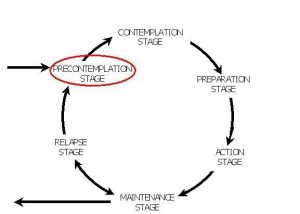
Recognising the Cycle of Change Stages: Quick Quiz:
Match the following SU statements to Cycle of Change Stages:
A: ‘I have been looking at which accounting course to do and have signed up to one’
B: ‘I missed my counselling appointment this morning and feel a bit down about it, but I have re-booked for next week’
C: ‘I got some bad news and after 2 months of being sober went on a 3 day binge resulting in arrest for drunken assault’
D: ‘I don’t care what others think, I am fine the way I am’
E: ‘I’ve been going to NA meetings for 6 months now, while I have some bad days and temptations, I haven’t used any drugs for the last 6 months’
F: ‘Doing an anger management course might help’
G: ‘I’m going to limit my visits to the pub to one night a week, and make sure I don’t drink more than 3 pints’
Answers:
A: Action B: Lapse C: Relapse D: Pre-contemplation E: Maintenance F: Contemplation G: Preparation